
Ideas for a Life of Purpose, Peace of Mind and Prosperity
Thoughts on money, behaviour and meaning, from Hendrik and the Craffies community.
- All
- Behavioural Finance
- Financial Coaching
- Financial Literacy
- Financial Planning

Two clients reach the same financial milestone and draw very different conclusions about themselves. A reflection for coaches and advisers on financial self-efficacy, interpretation, and helping clients learn what their experiences say about their capability.

Some weeks the research lands quietly. This was not one of them.

Whole-life financial coaching treats money not as a separate box to be managed, but as one thread woven through a person’s health, work and relationships.

Most of us have a money moment we have never told anyone about. A debt that grew quietly, a decision we regret, a statement we stopped opening.

A few weeks ago I was listening to Ronel Jooste’s podcast, and her conversation with Tal Ben-Shahar on the SPIRE model stopped me mid-walk.
I want to ask you something before we get into anything practical.
A conversation with Marius van der Merwe, CEO of Amity Investment Solutions, had me thinking. We were unpacking his Financial Wellbeing Model, and somewhere in that conversation I found myself asking a different question entirely.
Most people know they should budget. Far fewer manage to stick to one.
A recent South African study published in the Journal of Consumer Behaviour (Nixon, 2026) explored why some retirement fund members choose to make early withdrawals under the Two-Pot system while others don’t.
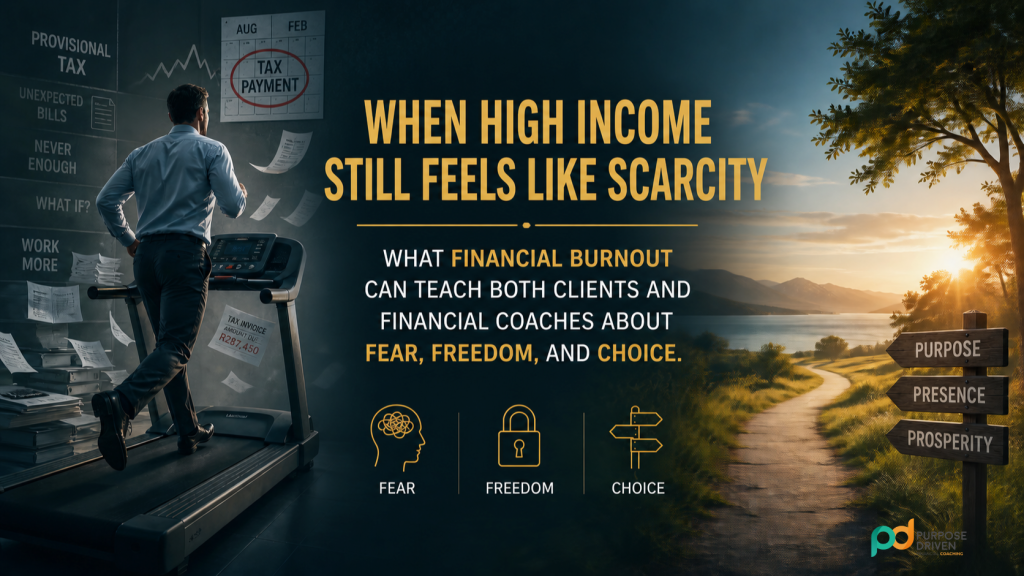
There is a quiet paradox unfolding in many financially successful professional lives. The practice is growing.
Have you ever noticed how quickly a conversation about money can turn emotional?
We all have an invisible slip of paper tucked inside our pockets—the one that whispers, “People would think I was crazy if they knew…” Maybe yours says, “If they knew how much debt I’m drowning in,” or “If they knew I’m barely holding things together…

We all aspire to live a life of abundance—not just in material wealth, but in purpose, relationships, and personal growth.
In our ever-evolving world, uncertainty has become a constant companion in our lives. How we choose to relate to this uncertainty can significantly impact our emotional well-being and the quality of our decisions.
Financial confidence is crucial to our and our clients’ overall well-being. It impacts our financial decisions and our emotional and mental health.
Breakdowns, viewed through the lens of ontology as expounded by the influential philosopher Martin Heidegger, represent a profound philosophical exploration of human experience. ” These breakdowns are far from being negative.
In the realm of financial coaching, understanding the psychology of money is paramount. Clients often come with myriad financial assessments that can empower or hinder their financial journey.
As financial coaches and planners, incorporating MI into our practice can provide valuable support to clients in overcoming challenges and developing new strategies. This article explores the essence of Motivational Interviewing and its relevance in financial coaching.
When it comes to personal finance, knowledge is power. Educating yourself about money management and investing can significantly impact your financial well-being.

Values can have a significant influence on an individual’s purpose. An individual’s purpose often reflects their deeply held values and beliefs, as it is shaped by what they consider most important in life.

As financial coaches and planners, it is vital to understand our clients preferred communication styles. Our clients’ communication preferences will influence how we communicate with them and present information.
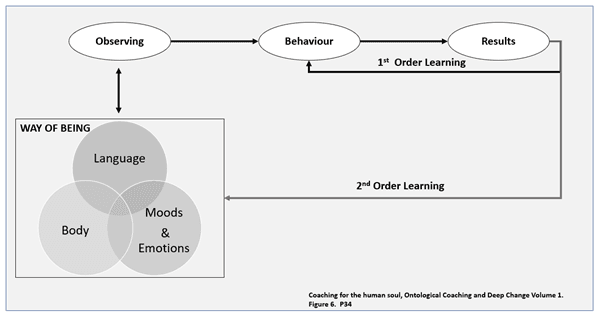
How we see the world is determined by the language we use, the mood we embody, and our bodies. In this article, we will explore how language create our reality of Financial Prosperity.
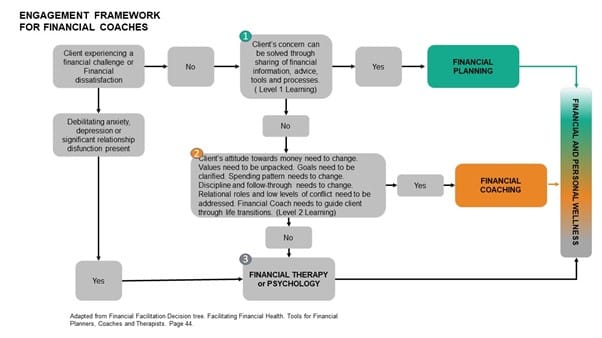
The following question often pops up in conversations around financial coaching: Do I always have to engage in a formal coaching process that consists of multiple sessions?
As financial coaches we see clients seek our services when they are experiencing some or other challenge and/or concerns that they cannot solve or see new possibilities for. For example, they get retrenched or battle to make ends meet.

10 Points of Integration between Financial Coaching and Financial Planning
Last week we explored What is Financial Coaching and I shared the following definition:

What is financial coaching? Financial Coaching intends to enable clients to achieve long-term prosperity by developing the competence to self-correct and self-generate. It is a collaborative process centred around the client’s agenda. The coach uses their tools of deep listening and powerful questioning to help their clients determine the direction, resources, relationships, and self-knowledge required to get them to where they want to go.
How do I decide on a financial coaching course? Putting myself in the position of a Financial Planner, Accountant, Coach, Therapist, or Psychologist who wants to learn more about financial coaching and expand my value add to my clients, where do I start looking for the right course for me?
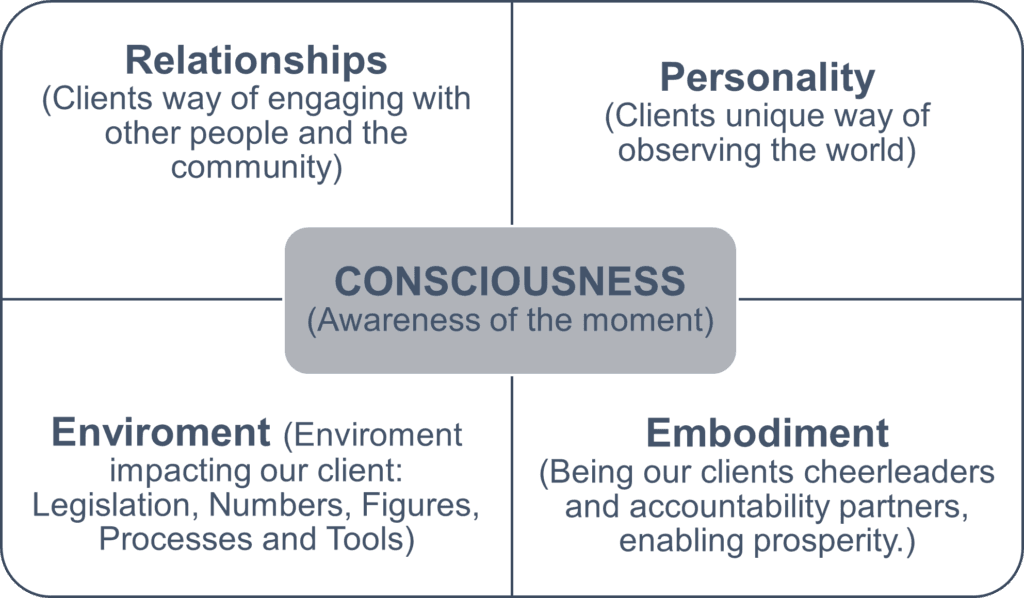
This is a question that continuously pop-up in conversations. In this post, we will ponder on this question.
Many people take no care of their money till they come nearly to the end of it, and others do just the same with their time.
In this talk at the Next Gen 2021 Conference, I share my view on how important financial coaching is for financial planners.
In the interview, Hugh Massie from Financial DNA and I discuss financial coaching and the behaviour smart financial planning process.
Acknowledging as Financial Coach and Client, we are already somewhere.

In 1978 Russian psychologist, Lev Vygotsky started working with Narrative Therapy in the form of Scaffolding. As a financial coach, I find the term very descriptive.
This week our fundamental question to Prosperity is: Could you please share with us some tips on how to create and sustain wealth? Dear readers, let’s explore this fundamental question, to the Art of Prosperity.
Working with a Financial coach will enable you as a client to live the life you want with the money you have.
In this conversation with Francois du Toit we discuss financial coaching for advisors, we also discuss where to start, financial coaching training and the financial coaching accreditation process.
We are proud to launch our 12 Week online course for financial planners in collaboration with the University of the Free State, School of Financial Planning Law.
Over the past few years, I did find inspiration in the work of Joshua Becker, although I must admit that I am far from a minimalist, some of the concepts is growing on me over time.
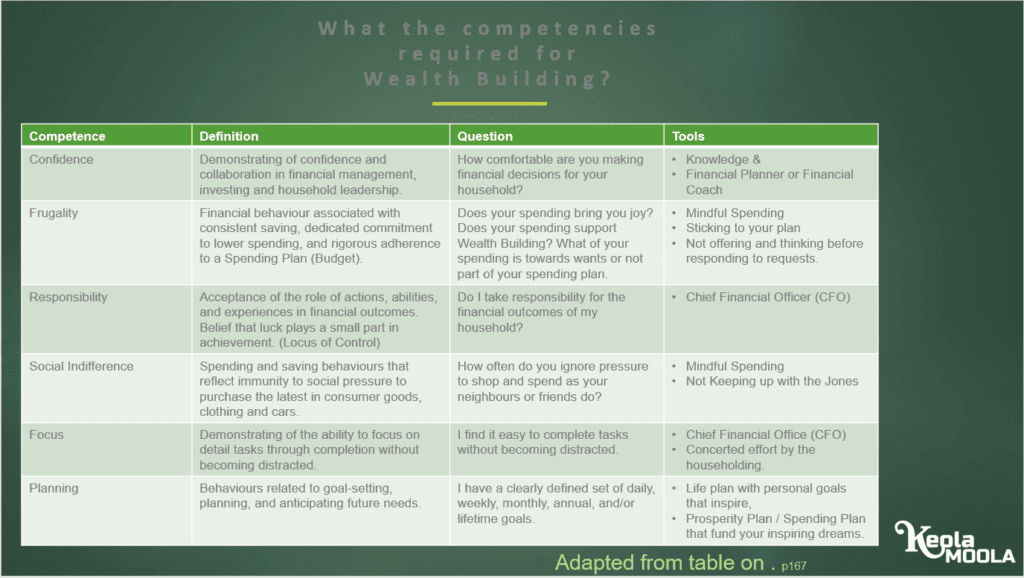
Keola Moola Wealth Club enjoyed reading and discussing, The Next Millionaire Next Door, if you missed the session, you can listen to the recording below.
In this conversation, we discuss what learners attending our three-day financial coaching course can expect from the training.
In the following conversation, we discuss the importance of Financial Coaching as a building block to support clients to live a life of purpose and prosperity.
In the video below the Money Wizard, share some essential building blocks needed to build prosperity successfully.
Craffies Coaching in Collaboration with the University of the Free States, School for Financial Planning law will be launching a twelve-week financial coaching course soon.