
In the interview, Hugh Massie from Financial DNA and I discuss financial coaching and the behaviour smart financial planning process.
What informs us to see Wealth and
Finances differently?
Acknowledging as Financial Coach and
Client, we are already somewhere.
Ever driven with your family in a nature reserve and the rest of the family sees a specific bird or animal, and you cannot see it? Yes, at that moment, you are observing differently, then the rest of the family.
You could ask, what has observing differently to do with change and financial coaching and supporting our clients? When our clients come to us with their concerns, they are battling to see alternative possibilities. It is then as our role as coaches, to help them build the capacity to observe differently. As financial coaches, we support the client to change their way of being, to enable them to observe what they are not seeing.
This article will explore how we can use the Adult Development theory framework to support us as Financial Coaches. I believe this can help us facilitate change more eloquently for our clients, as we address their concerns. The process will also enable the change to be more sustainable as we meet the client where they are—helping them grow the competencies and ways of being needed to deal effectively with their concerns.
We will explore the subject in two parts. Firstly, we will look at the theory of Adult Development and the intersections with Ontological Coaching. Secondly, we will explore how the model could be adapted to create a Financial Developmental Framework.
Adult Developmental Framework
To unpack the framework, we draw on Robert Kegan’s work, referring to the work documented in, “In over our heads, the mental demands of Modern Society”. We will then explore the interpretations and integration that Alan Sieler documented in Coaching for the Human Soul Ontological Coaching and Deep Change Volume II.
As suggested by the title of his book, In Over Our Heads, Robert Kegan argues that change around us, more often than not, is happening faster than the development of Human Consciousness. From an ontological perspective, we could say we have learned to observe and live in a particular world with familiarity when the world changes suddenly. Our way of being, our ability to observe, was serving us well in the old familiar world but cannot support us in the changing environment unless we expand our consciousness.
Thinking of the world of finances and change, for a client, this could range from getting divorced, a parent passing away, and a child taking over a family business. It could also include changes like getting a promotion and dealing with the new complexity of the job demands, to name a few challenges. What about the complexity of Estate Law, Tax Law, Pension Law, Product complexity, Technology, and so on. All this contributes to the ever-changing world of finance our clients, and we need to deal with.
Expanding our consciousness enlarges our capability to deal more skilfully with an ever-changing world and our challenges, concerns and breakdowns. In cases where our clients and we do not expand our consciousness, we become trapped in negative assessments, false assertions and moods of anxiety, resignation and resentment. Through Ontological Financial Coaching, we can shift our way of being to a more useful state where we can speak a different language, shift to more helpful moods and practise more supportive body postures.
Keagan mapped development into five distinct stages. Some important principals to take note of, before we explore them:
- Shifting from one stage to the next stage is a transformation and broadens our consciousness on cognitive, emotional, social physiological and moral levels,
- We can then say that consciousness is our way of being, and our capacity to make meaning at that specific level,
- No level is superior to the other. At all levels, we are still human beings that from time to time, act from our personalities and not from our centre,
- Transforming to higher levels is like a Russian doll. We can always still access the lower levels,
- As coaches, it is then vital to understand if we do not evolve, and we encounter clients at a higher level, we will struggle to observe them at their level of consciousness.
- Broadly speaking each higher level of consciousness supports us to:
- Broaden our understanding of the world,
- Enables us to be more inclusive,
- Enables us to see the paradoxes that exist in the world (more comfortable to see the grey),
- Enables us to see more opportunities that we can take part in.
The table below gives a summary of the five levels of consciousness:
Keagan refers to the concepts of subject and object to explain how we shift our ability to observe as we develop, grow and transform between the levels. As subject, we begin to emerge from our way of observing, still unable to distinguish between the woods and the trees. As we transform, we can distinguish between the woods and the trees. We become the observer of what was previously the subject. Now we become the object.
| Stage | Subject | Object | Underlying Structure of Interpretation |
| First stage (1-6 years)
Impulsive Stage |
Fantasy, Impulse (Own needs and Feelings) and Perceptions | Movement and Sensations | Thinking: Fantasy. the focus is detailed and on a single point. What they observe is their reality. Relationship: Immediate needs. |
| In this stage, children need to be reminded of rules and risks constantly as they don’t hold these concepts for long in their minds. This stage is a time of magic and mystery; the world frequently changes, so they enjoy these moments in a mood of wonder.
Take the example of a client who inherits a large estate or wins the lotto. A client at the first stage of development, will not be able to think long-term and will be engaging in allocating the inheritance with impulsiveness and fantasy. |
|||
| Second stage (6-12 years)
Concrete Operational (Research indicates that 13% of people between 19-55 still hangi out here) |
Concrete:
Actuality, Inquisitive (Want to know how the world fits together). Data & Cause and Effect Point of View Role-Concept Simple reciprocity Enduring dispositions Needs Preferences Self-Concept |
Fantasy, Impulse and Perceptions | Thinking: Looking for structures & categories. Also, looking for order and stability.
Language: What is the tallest you can grow? How many bones are there in my body? What does the doctor hear if he listens to my heart? Relationship: Tit-for-tat, End to a Means |
| In Stage two: People realise that they have beliefs and feelings that remain constant over time. They realise that people have opinions and beliefs. This influences particular like’s and dislikes. These realisations create an understanding that rules stay constant. If they do not agree with the rule, they will either worry about the consequences of not adhering to the rule or look at ways to circumvent. In this stage, individuals cannot hold their own opinions and those of others at the same time. Generally, people in this stage are rule-bound and buy into benefit from external rewards or fear of punishment.
Taking the example of a client who just inherited a large sum of money, if the client’s level of consciousness is in Stage 2, the client will explore how they could utilise the inheritance to address their needs and preferences. |
|||
| Third Stage (Teenage and beyond)
Socialised mind or Traditionalism (Research indicates that 43% of people between 19-55 still hang out here) |
Abstractions: Ideality, Inference, Generalisations, Hypothesis, Propositions, Ideals and Values.
Mutuality: Role Consciousness Mutual Reciprocity Inner states: Subjectivity and Self-consciousness |
Concrete:
Actuality, Inquisitive (Want to know how the world fits together). Data & Cause and Effect Point of View Role-Concept Simple reciprocity Enduring dispositions Needs Preferences Self-Concept |
Thinking: Moves beyond concrete and factual to abstract reasoning and conceptual thinking.
Language: What am I here for? What is love? How can I achieve happiness? Is it right or wrong to…? Relationship: Mutual Reciprocity Behaviour: Testing boundaries, social norms and becoming part of a community. Also, adopting the values of people and systems that they find essential. This becomes their assertions, values, and beliefs they live by. |
| In Stage Three, people adopt the values of families, organisations, and philosophies. They put their desires below those of their meaning system. Other people’s ideas and emotions are assessed against the meaning-making system. Thinking in abstract ways, be self-reflective, about their own and others’ actions. They are devoting to something bigger than themselves.
Kegan makes the distinction that in this stage, people invite a Board of Directors into their life, into their decision making. This Board of Directors is now voicing in their heads that influence their meaning-making system. A significant limitation in this stage is where there is a conflict between the voices of different Directors. Furthermore, people in this stage cannot develop their mental model or integrate different concepts and beliefs. Secondly, in this stage, people do not have an independent constructed self and rely on others’ feedback as the people around them make up their mental models. People in this Stage are great followers of a strong culture. They also tend to focus on one role or domain in life, as more than one role or domain causes conflict for them. Take an example of a client who just inherited a large sum of money, if the client’s level of consciousness is in Stage 3, the client will explore how others (people that influenced their life) would have dealt, utilised and invested the money. |
|||
| Fourth Stage
Self-authoring mind or Modernism (Research indicate that 34% of people between 19-55 hang out here) |
ABSTRACT SYSTEMS
Ideology: Formulation, Authorisations, Relationship between Abstractions. Institution: Relationship-Regulating Forms, Multiple Role Consciousness Self-Authorship: Self-regulation, Self-Formation, Identity, Autonomy, and Individuation. |
Abstractions: Ideology, Inference, Generalisations, Hypothesis, Propositions, Ideals and Values.
Mutuality: Role Consciousness Mutual Reciprocity Inner states: Subjectivity and Self-consciousness |
Thinking: Willing and open to challenge the taken for granted beliefs.
Language: Moving from living other people’s stories (values, beliefs and assessments) to being the narrators of their own stories. Useful Moods: Possibility, Ambition, and wonder. Relationship: Community, other and interrelationships. Behaviour: Abundance vs a Scarce mentality. |
| In Stage 4, the person becomes the Chair of the board and questions and interrogates the values, beliefs, and philosophies. The big difference is that the person can still hold the same values and beliefs. However, it is their own, and they understand why they support them to believe what they believed. They no longer feel torn apart between different beliefs or systems as they have their own. They can also integrate different roles, for example, worker, husband and dad. However, this could cause internal conflict, as their meaning-making system could guide a person to spend more time at work while another part wants to spend time with family.
Take the example of a client who just inherited a large sum of money. If the client’s level of consciousness is in Stage 4, the client will explore how they could utilise the inheritance in the best way they see fit the benefit of themselves and others. They will most probably consult different sources, to form their opinion on how to utilise the funds in the best way. |
|||
| Fifth Stage
Self-transformation mind or Post-Modernism (Research indicates that 3% of people between 19-55 hang out here) |
Trans-Ideological
Testing Formulation, Paradox, Contradictions and Opposites. Inter-Institutional Relationship between forms. The interpenetration of self and others. Self-transformation Interpenetration of Selves Inter-Individuation |
ABSTRACT SYSTEMS
Ideology: Formulation, Authorisations, Relationship between Abstractions. Institution: Relationship-Regulating Forms, Multiple Role Consciousness Self-Authorship: Self-regulation, Self-Formation, Identity, Autonomy, and Individuation.
|
Thinking: Going beyond developing their own identity and ideology and setting their boundaries about how they will and will not engage in different life aspects.
Language:
Moods: Comfortable to take on a mood of ambition and wonder, while living with uncertainty. Relationship:
Behaviour: A Healthy detachment from how they view themselves and the world. Can also hold contrasting viewpoints and acknowledge paradoxes. |
| In stage 5, people can see the similarities in people’s beliefs, although, on the surface, there are seemingly significant differences. They are comfortable to deal with paradoxes and the tension between different truths. People in this Stage see the Board of Directors merely as opinions and entertain this input to make their meaning-making richer. Observing people in this stage: It seems as if life just happens as if inflow.
Take an example of a client who just inherited a large sum of money, if the client’s level of consciousness is in Stage 5, the client will explore how he or she could utilise the funds, for themselves, and their family and create a legacy. |
|||
Adapted using: (Kegan, 1994)
Here is a summary of Robert Kegan’s 5 Orders of consciousness in an animation video:
https://youtube.com/watch?v=mW4LTqRJDW8%3Ffeature%3Doembed
Seven Habits of Highly effective people
Let’s take a short detour and reflect for a moment what Stephen Covey shared in “Seven Habits of Highly effective people.” This could be helpful to enrich our discussion on looking at a Financial Development Framework.
Covey make the point that we start on our journey of life as being dependent. We need to work towards Private Victory, acquiring the competencies of: Being Pro-active, Begin with the end in mind and First things first. We then move from being dependent to Independent. The second phase is then to achieve Public Victory. To master this stage, we need to build the following competencies: Think Win-Win, Seek first to understand… Then to be understood and Synergy, all supported by being a full-time learner. When we integrate Personal and Public Victory, we become Interdependent. (Covey, 1992, p. 63)
Practice to Freedom
Wendy Palmer, in The Practice of Freedom, shares a model of Four Developmental levels. This offers a vivid distinction, describing the levels. The first level is described as Anarchy, referring to chaos. Level two is described as Etiquette, where we want to live, life according to society’s rules. Level three is described as Morality, where we change from doing what we belief others think is the right thing to do, to what we think is the right thing to do. Lastly, in Stage four, we move to Compassion, where we live to serve.
Financial Development Framework
The framework was developed using the three frameworks I have discussed. It offers a living document that evolves through conversations with fellow coaches and interactions with clients.
| Stage | 1 | 2 | 3 | 4 |
| Name | Dependent | Independent | Interdependent | Transcendence |
| Mapping to Keagan’s Stages | Stage 2 | Stage 3 | Stage 4 | Stage 5 |
| Mapping to Stephen Covey’s Seven Habits | Seeking Personal Mastery | Achieving Personal Mastery | Seeking Social Mastery | Integrating Personal and Social Mastery |
| Mapping to Wendy Palmers – Practice of Freedom | Anarchy | Etiquette | Morality | Compassion |
| Theme | The world is unsafe and in flux | Follow the rules, process, and structure | Offer your gift to the world | Living a Vocation |
| Role of Money | Survival | Satisfying own Needs | Supporting others because I want to | Philanthropic contribution |
| Attitude towards money | There is not enough | If I earn more money, I will make ends meet | Money is an exchange for the value I add. It gives me a choice | Money is an enabler to do good for the world. |
| Language | Life is not fair. Other people have it all. I was born to struggle. There are no opportunities.
Why me? Assessments of being powerless, a victim and living reactively. |
When I see something, I need it. The next thing I do will be my big break. Only I can do it. I cannot miss anything. Complaining about life and finance as if one has no input in life. | We have a unique contribution to make. We create opportunities through conversations.
My life is filled with meaning. |
How can I make the world a better place?
How can I give back? How do I create a legacy? How can I help others? |
| Possible Moods | Resentment, Anxiety, Panic, Anger & Blame | Anxiety, Overwhelm & Frustration. Industrious busyness. Arrogant. | Wonder, Ambition, Gratitude & Confident and Persuasive. | Being Content |
| Relationships | Me | Me vs You
I am interested in others to get what I want. |
Me and You
We are helping others to achieve what we want. |
World |
| Possible Interventions: Working with the Way of Being (2nd order learning) (Seeing) (Attitude towards money and prosperity) | ||||
| General | Need to work towards baby steps—small steps of reflection and tiny gains. Get the client to move from drawing to peddling. Meaning? | Confront the assessments that doing and following the “rules” will bring relief. Furthermore, it could be to work with building self-worth and taking ownership by making supportive declarations. | Integrate and explore the Assessments that a client has. Which of these are useful and which of these cause the client to derail? Support the client to move from problem-solving to problem finding. | You are a thinking partner to the client.
Help the client to think about creating a legacy and about transitions and philanthropy. |
| Language | Coach them to observe how Assessments (Self and other) contribute to their current way of being. What new language could be more useful? | Coach clients to ground the assessments they have around following assertions and assessments that are not serving them, that were created by communities, organisations, and themselves. | Coaching clients to explore their assessments.
We are exploring how they use requests for support. What offers are they making? What is their true north? What declarations are they making? |
Coaching clients to get clarity on their declarations? Coaching client to balance power and love.
Coaching clients to take action based on grounded assessments. |
| Mood | Coach them to observe how Moods contributes to their current way of being. What alternative moods will be more useful? | Coach them to observe how Moods keep them from taking ownership, having, and taking action. What moods will be more useful? | Coach them to observe how Moods keep them from learning, staying open for wonder and ambition.
What moods will be more useful? |
Coach them to explore what moods will be most useful to them where they are in life. |
| Body | ||||
| Grounding | Stop three times per day and take a deep breath.
Stretch |
Stop three times per day, breath and speak your declaration. | Three-Way Breathing. Breath into, head, heart and gut. Three times and then once in all centres at once.
Mindfulness practice 10 Min |
Sitting practice 20 min
Loving Kindness Practice. |
| Financial Practice | Stop three times a day and confirm your declaration. | Journal and write down your declarations. Write down what worked and what you want to change. | Journal and write down your declarations and what you are grateful for. Write down the learning you had. | Journal and write down your declarations and what you are grateful for. Write down the learning you had. |
| Possible Intervention: Working with behaviour, process, and Tools. (1st order learning) | ||||
| Exploring what is essential for the client now. Triage (Stabilise) with focus on small steps that can be done now. | Exploring clients dreams and aligning with Values. | Support request. Involving all stakeholders. | You are a thinking Partner. | |
| Budgeting, debt management and stabilising money management and mitigating key risks. | Planning, Risk Mitigation, saving. | Scenario’s, planning for possible life events, building and sustaining wealth. | Creating a legacy, Transition and Philanthropy. | |
Would love your input and thoughts on the article, specifically the adaption of Adult Development Levels to financial planning.
Bibliography
Covey, S. R., 1992. The Seven Habits of Highly Effective People. 1992 ed. London: Simon & Schuster UK.
Kegan, R., 1994. In over our heads, The Mental Demands of Modern Life. 1994 ed. London: Harvard University Press.
Kegan, R. & Lahey, L., 2012. Adult Development and Organizational Leadership. In: N. Nohria, ed. Handbook of Leadership Theory and Practice: A Harvard Business School Centennial Colloquium. Boston: Harvard Business Press, pp. Chapter 26, Pages 1-19.
Palmer, W., 2002. The Practice of Freedom. 2002 ed. California: Rodmell Press.
Sieler, A., 2007. Coaching to the Human Soul, Ontological Coaching and Deep Change Volume 2. 2007 ed. Victoria: Newfield Australia.
Interesting further reading:
Kinder, George. Seven Stages of Money Maturity
In 1978 Russian psychologist, Lev Vygotsky started working with Narrative Therapy in the form of Scaffolding. As a financial coach, I find the term very descriptive.
Scaffolding is a method widely used in teaching to determine the skills that a student has, and which skills need further development. From there on, they place focus on building these required skills and competencies through layers. I guess you could say, taking it step by step, literally.
In the same way, we sometimes use scaffolding or narrative coaching to explore and determine a challenge that a client may experience and then help them build competency to overcome them while empowering them to continue their financial responsibilities with ease.
In 2011, a research paper published by the University of Western Sydney investigated how to use scaffolding to support students to learn and integrate the complex concepts of financial planning, but we will explore how we can apply scaffolding in supporting clients in their zone of proximal development (where their current knowledge and experience, or need to be expanded to deal with the task or issue at hand), in this article.
What is Narrative Theory
In the early 1980s, Michael White and David Epston brought the concept of narrative practice to mainstream society as what we now know as narrative coaching through the development of narrative maps that gave practitioners a specific structure that made the process visual.
After attending a series of workshops about re-authoring the world, some years back, which were hosted by Chené Swart, our own South-African Narrative Guru, I have found a new appreciation and viewpoint through Narrative theory, for reasons such as;
- We construct reality.
- Reality is both influenced by and communicated through language.
- Knowing narratives help us organise and maintain reality.
- Critical thinking: Does absolute truth exist?
- The process of non-blaming.
- Externalising the challenge (the problem is the problem and not the client).
- Respecting the client as a unique human being.
- That the client is the expert of their own life.
Can Narrative Theory fit into the Ontological Coaching Framework
Writing an article on Narrative Theory or Narrative Coaching would not be complete if I didn’t explore how it could fit into an Ontological Coaching Framework. At the core, we are human beings that live in stories or narratives. We either form these stories or re-tell them through the conversations we have.
It forms our conversations through our listening, speaking and the mood and energy we use to craft these narratives. By creating these through talking, writing and thinking, these stories are generally about us (self-talk.)
Looking at language, they form our stories on assessments we make that are based on our values, beliefs, and judgements. Our stories are influenced by the assertions formed by our culture, communities, and systems we grew up and lived in.
Allan Sieler summarises it as:
“… Assessments that influence our stories [which] are formed based on past experience[s] made in the present, and [will] inform how we will view the future or how we will take action in the future.”
Reflecting on the words of Walter Anderson,
“We repeatedly create symbolic systems of meaning-religion, political ideologies, scientific theories – and forget they are our own creations.”
I cannot help but think time and money were both concepts and stories that we as humans created therefore, how we frame our stories around these will either leave us with a mindset of abundance or scarcity.
My way of being as a Financial Coach
As a financial coach, we can use the narrative approach by listening to our client’s stories while picking up parts we are curious to explore, irrespective if these stories are positively serving them or not. The other possibility is where clients come to us and present something that is a challenge for them.
In both cases, it is essential that we do not act by judging, relating, or applauding their challenge. We are also not the expert to assume or fix, as a financial coach, we can walk alongside the client while they explore and re-author their story.
Our own way of being critical and applying the narrative theory correctly is to ensure that we are present, to stay and observe the client’s story, while taking part in deep listening while asking significant questions to enable the client to re-author their story.
Creating or building a new narrative
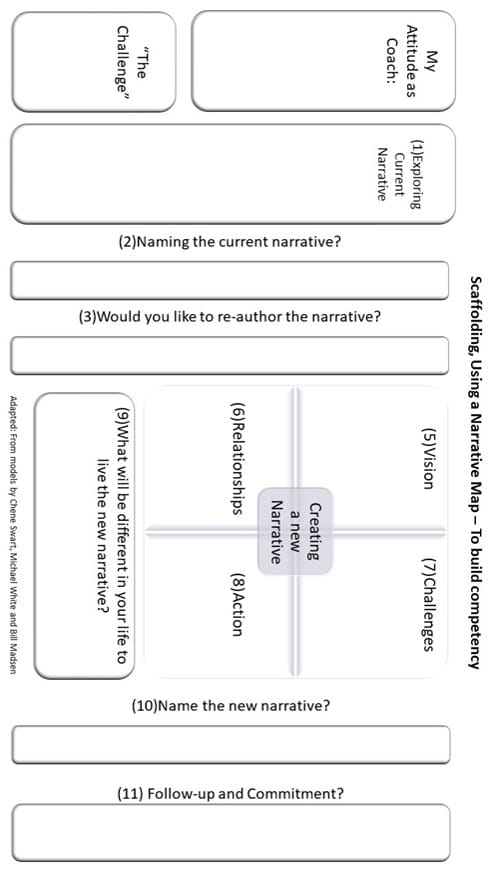
Below, there is a template you can use to facilitate the flow of the process. The framework was adapted using concepts from Chené Swart, David White and Bill Madsen’s work.
As a financial coach, when the client presents a challenge, or we are curios to explore something a client shared, we always need to ask permission to explore the story as we are curious to understand how the story support or handicap the client. We will explore how we can use one of the two mainstream techniques to facilitate the process.
Firstly, you can work with the client’s story and facilitate a process where they will re-write their story to find new ways and meaning.
The second method is to externalise the story, this could be very powerful depending on the context of the challenge. Using this method, you can ask the client to view the challenge as a third person in the room, helping the client to talk about the problem, separate from their own identity. This will allow the client to separate their emotional bias from the current challenge.
Step 1: Exploring the current Narrative
| Questions, unpacking the Narrative as a story | Questions, externalising the story |
| How did the narrative show up in the recent past? | In which of the past experiences was the narrative (person) present? |
| What evidence do you have of the narrative? | What evidence is there that the narrative shows up? |
| What is the narrative doing? | What would you say is the narrative doing? |
| What emotion is the narrative causing in your life? | What is the narrative causing in people’s lives? |
| How does the narrative impact your life? | How does the narrative impact people’s lives? |
| What are the assessments that influence and form the narrative? | Suppose you listen to the stories of the narrative. What are the assessments that influence and form the narrative? |
| How do these assessments influence the narrative? | How do these assessments influence the narrative? |
| Who gives authorisation for the narrative in your life? | Who do you think gives authorisation to the narrative, to life and to influence people’s lives? |
| How does the narrative influence your relationship with:
· Yourself · Your body · On a Spiritual level · Your work, and · Relationship with others.
|
How does the narrative influence people’s relationship with:
· Themselves · Their bodies · Spirituality · Their work, and · Relationship with others.
|
| When is the narrative at its strongest and weakest in your life? | When is the narrative at its strongest and weakest in the lives of people? |
| How do you “side-step” / avoid the narrative? | How do people “side-step” / avoid the narrative? |
| Was there a time in your life that the narrative was not present? | Was there a time in people’s lives where the narrative was not present? Is the narrative present in all people’s lives? |
| 1. Assessments are also sometimes referred to as “taken for granted beliefs”. These are the “truths” we live by, that we no longer question. These could be our own or others’ assessments of things, judgements, values or even assertions that are driven by culture, community or norms that become part of our discourse. | |
Step 2: Naming the current Narrative
Observing the narrative from an outside objective, one could label the narrative. This again helps us separate the challenge from the client. What would you name your narrative/challenge?
Step 3: Deciding to explore a new narrative
| Questions, unpacking the Narrative as a story | Questions, externalising the story |
| How does the Narrative serve you? | How does the Narrative serve people? |
| How does the Narrative run your life? | How does the Narrative run people’s lives? |
| If you can, would you like to write a new story to live by? | |
| What relationship will you have with the old narrative? | |
Step 4: Ritual to Say Good-Bye to the old Narrative
- What method or routine will be worthy to say goodbye to and thank the old narrative?
Step 5: Envision the new Narrative
- What would you want from the new narrative?
- What experiences of your past can you draw from to support the new narrative?
- What assessments (beliefs, values, assertions and ideas) support the new narrative?
- What mood best supports the new narrative?
- Who will you allow to speak to the new narrative?
Step 6: Explore the new narrative in the context of relationships
- Who will be influenced by the new narrative?
- How will they be influenced?
- Who will you ask to support you with the new Narrative and how?
Step 7: Explore possible challenges within your new narrative
- What potential challenges might stand in your way?
- How will you mitigate or deal with these challenges?
Step 8: Acting
- What will you need to do to live the new narrative?
Step 9: Envision the benefits of the new narrative
- What difference will the new narrative make in your life?
- What routine would you like to have to integrate the new narrative into your life?
- What routine will you have regularly to remind you of the new narrative and to be grateful for the new narrative?
Step 10: Name the new narrative?
- What will be the name of the new narrative?
- What declaration are you making?
Step 11: Follow-up and commitment
- What realizations did you experience during the process?
- What support do you require from myself as your financial coach following your new narrative?
- As a financial coach, you will enter a verbal agreement of accountability and recognition for an agreed future date.
Fellow Financial Coaches, would love to hear your views, questions of stories how you applied the framework?
Additional Resources
Books:
Re-Authoring the world, The Narrative Lens and Practices for Organisations, Communities and Individuals, Chene Swart
Maps of Narrative Practice, Michael White.
Online Resources:
Chené Swart – https://transformations.co.za/treasures-2/
Dulwich Centre, Michael White – Resources https://dulwichcentre.com.au/michael-white-archive/
Positive Psychology, Narrative Therapy Resources https://positivepsychology.com/narrative-therapy/
This week our fundamental question to Prosperity is: Could you please share with us some tips on how to create and sustain wealth?
Dear readers, let’s explore this fundamental question, to the Art of Prosperity. We would start by looking at Nine Key Building Blocks to Wealth and Prosperity, that we will explore in more depth over the next weeks.
Your attitude towards Prosperity
How you think and relate to my friend, Money will determine your actions. The language you use will create your future action to grow and sustain Prosperity and, your mood, how you feel will enable you to take action. Your attitude will determine if you will create a life of Prosperity or Suffering.
When you have an attitude towards Prosperity, you will have an abundance mentality and a sense of gratitude.
The following quote by, Paul Zaiter, is worth pondering on; “There is a natural law of abundance which pervades the entire universe, but it will not flow through a doorway of belief in lack and limitation.”
Have a living Financial Plan
If you want to embark on growing and sustaining Prosperity you need, to have a plan. Stephan Covey referred to it as have the end in mind. He also said if we have an end destination and if life pushes us off track, we know where we are going, and we can correct and keep focusing on working towards our end goal.
When crafting a plan that will enable us to live a life of Prosperity, Meaning and Purpose with the resources (Money) we have, it is essential to integrate the following:
- Your Values, as your values, determine what is vital for you,
- What activities spark meaning in your life’s?
- What do you want to achieve in each of the different domains of your life? Which of these need Money to enable it?
- How do you allocate resources to achieve these goals?
- Your detail cashflow,
- Risk Plan, which addresses what you will do if a life-changing event take place in your life,
- An action plan addressing:
- What do you want to change in terms of your attitude and behaviour?
- What do you want to achieve in terms of building and sustaining Prosperity?
To enable you to live the best possible life, with the resources you have!
Thinking Income
How you describe and think about Money, how you receive is an essential part of building Prosperity. Do you think of it as a salary that you receive? You could also see it, as you receiving remuneration for your skills, that you offer your employer or clients! In the second scenario, you are offering a gift to the universe, that adds value, and the universe let Money flow back to you in return. You have a resource (your skills and labour) of value to offer the world.
Having a Prosperity mindset, you will think about what resources do I have, that you can utilise optimally to create a sustainable source of income. Broadly you will be able to categorise these into Labour, Capital (Investments and Business) and Property.
You will also continuously be exploring, options on how to grow your source, which bring us to the next point of building Prosperity, how we allocate the income from the source.
Allocating Income
How you will allocate the income you derive from your source, will determine if you will be growing your Net-Worth, which is a crucial driver toward building and sustaining Prosperity. I have a friend Frugality, and he over the years visited households that cracked the code towards Prosperity. Frugality found that these households have built the following competencies to support them in growing their Prosperity:
- Spending less than they earn,
- Having confidence in making money-related decisions,
- Control to make short-term decisions that will have long-term benefits,
- Have a plan (Cashflow) and monitor it,
- Focus, have the discipline to stay with their decisions, and
- Social In deference, not to be sidetracked by what others do.
The excellent news is that my friend, Frugality found that when we are aware of the above, we can build these skills, to master the Art of Prosperity. Frugality base the conclusions on the research in The Next Millionaire Next door.
Frugality also observed an interesting point that these people always saved a portion of their income to grow their source. Some prefer first to allocate a percentage of the income from the source towards saving and investing and then allocate the rest towards giving and living, others take an integrated approach of allocation, however in all instances they save and invest with discipline.
Interest the blessing and the evil
My friend Money, have an exciting story to share regarding interest. He is always willing to add interest; however, this could either be an asset to you or liability. If you invest, Money will respond and pay you interest. When re-investing this interest, Money will reward you with compound interest by adding interest to the interest. Einstein referred to compound interest as the most powerful force in the universe. Saving regularly, leaving your capital to grow with compound interest is one of the golden rules of building Prosperity.
Money on the other side will make itself available for you, to borrow it. When borrowing or lending Money, will require you to pay interest for utilising it, as you are using it, with-out owning it. It is vital to think about what you want to do with Money carefully. Using a loan, where you, will be paying more interest, than the income you earn on the asset or venture is a liability, and is an expense.
Opportunity Fund
I love instead to call an Emergency Fund an Opportunity Fund. As having an Emergency Fund, refer to the fact that we would use these funds in an emergency. On the other side of the coin, if you have an opportunity fund, and live happens to you, you do not have to take forced decisions. Rule of thumb is to have an Opportunity Fund with a balance equal to at least six months of income.
An opportunity fund is essential to protect your journey to Prosperity.
Plan and Protect yourself, for when life happens
Dear Reader, over the years, I have seen many people setting out to search for Prosperity, and doing everything right, and then life happens. They lose their job, get disabled, get divorced, need to support extended family, and they did not consider these curveballs. All of a sudden, all their plans come to an end. There is a saying that life will not yield to a plan; a plan will yield to a plan.
Locus of Control is one of the biggest drivers for people to achieve Financial Wellness, find Prosperity. Locus of Control in this context is the ability to preempt possible changes in their financial situation and proactively plan for it.
Knowledge
On the topic of Financial Knowledge, there will most probably be as many views as there are people. Basic knowledge of the critical concepts of finances is essential on the journey to Prosperity. However, as you do not need to know the exact process, and technical jargon, that electricity goes through from the source, up to the point you put on the light. You also do not need to know this when dealing with finances.
My suggestion will be to acquire just in time knowledge when dealing with finances. Understand and have a working knowledge of the building blocks. When then confronted with a more advanced topic, you can either engage a reputable specialist, source or your Financial Coach to help you build the competency deal with the matter.
Have a Financial Coach
My friend Money informs me that most people experience making decisions around Money, usually is emotional, which in most cases lead to making not that wise Money decisions. Having a Money Coach will give you somebody to use as a thinking partner, not only to be your thinking partner when you need to make crucial decisions regarding Money. The Financial Coach will also be your thinking partner to use the building blocks to help you on your journey to achieve and sustain Prosperity.
Conclusion
In conclusion, to master, the Art of Prosperity, (1) Have a plan, (2) Spend less, than you earn, (3) Save diligently in a diversified portfolio, (4) Plan, proactively for when life happens, (5) Have a Financial Coach. That can act as a thinking partner, help you build the competencies and skills to grow and sustain Prosperity and to guide you through life’s ups and downs.
Would be great to hear, from you what you see as the primary building blocks to Prosperity? What questions do you have? What would you like to read about in the Blog?
Regards,
Prosperity
Working with a Financial coach will enable you as a client to live the life you want with the money you have. The Financial Coaching session will enable you to reflect, plan and implement a plan to support you in building a life of prosperity, that will take you dreams, concerns, and values into consideration.
http://https://youtu.be/9f4Lj2FDeC0
Importance of Financial Coaching
Money Matters is normally emotionally loaded. A Financial Coach will be your thinking partner, to help you understand your strengths that enabled you to become successful. The Coach will also explore you believes of money and life that sometimes trip you up. The financial coach will support you to explore your history, your current reality and where you plan to be financially in the future. The financial coach will be your thinking partner to support you in making the best possible decisions to support you growing your net-worth and live a life of meaning.
Benefits of Financial Coaching
Financial coaching can help you to develop a life that is filled with meaning, while growing your prosperity (net-worth). Let us look at some of the unique benefits of embarking on a Financial Coaching journey. The following is some of the benefits you will be able to reap by engaging with a well accredited Financial Coach:
- Making wise financial and life-decisions, aligned to what is important to you,
- Aligning and creating order around your finances,
- Follow through on your dreams and commitments,
- Planning proactively where possible, else navigating life’s transitions,
- The Financial Coach will bring objectivity to emotional money matters, and help you to avoid emotional driven decisions,
- The Financial Coach will share just in time knowledge, to empower you with money wisdom, to make informed decisions and
The Financial Coach will be in partnership with you, to help you align your money to your means to enjoy and sustain a life of meaning and prosperity.
In this conversation with Francois du Toit we discuss financial coaching for advisors, we also discuss where to start, financial coaching training and the financial coaching accreditation process. We reflect on the difference between traditional financial planning and personal financial coaching. How to focus on the clients agenda and the benefit for all involved. Enjoy the 60 minutes of conversation.
We are proud to launch our 12 Week online course for financial planners in collaboration with the University of the Free State, School of Financial Planning Law.
For more detail follow the following link: http://ow.ly/iX6v50AUdeT
Can also see a detailed short description on Facebook.
Over the past few years, I did find inspiration in the work of Joshua Becker, although I must admit that I am far from a minimalist, some of the concepts is growing on me over time. In this post, I want to share the following YouTube talk (7 Min), where Joshua shares seven pieces of financial advice that changed his life forever as he states :
In summary, the seven golden nuggets are:
- Shortage in most cashflows is caused by either To Much House, To Much Car or To Much Entertainment,
- When getting married life on one income, where possible,
- Always by cars with cash,
- Have a spending plan, and stay within your means (Also three of the competencies that we learned from the Next Millionaire next door, being Frugal, Plan and Focus),
- Pay your bond off faster,
- Get yourself a job that gives meaning to your life and pay the bills,
- You are never too poor to give.
At first sight, simplistic ideas, however not that easy to practice these that all of them become second nature or habits in our life.
Keola Moola Wealth Club enjoyed reading and discussing, The Next Millionaire Next Door, if you missed the session, you can listen to the recording below.
Some key thoughts from the book::
- Economic independence belongs to those with the willingness to allocate, money, energy, and cognitive resources to achieve financial goals,
- Financial independence is important for all ages, for both the “FI/RE”(Financial Independence Retire Early) community or people that get to traditional retirement and need to Refire as Ken Blanchard and Mont Shoevitz positioned it,
- Never confuse income and net worth,
- Have a Chief Financial Officer to support you on your journey, and
- Their research indicated that there are six key competencies that are critical to support building wealth.
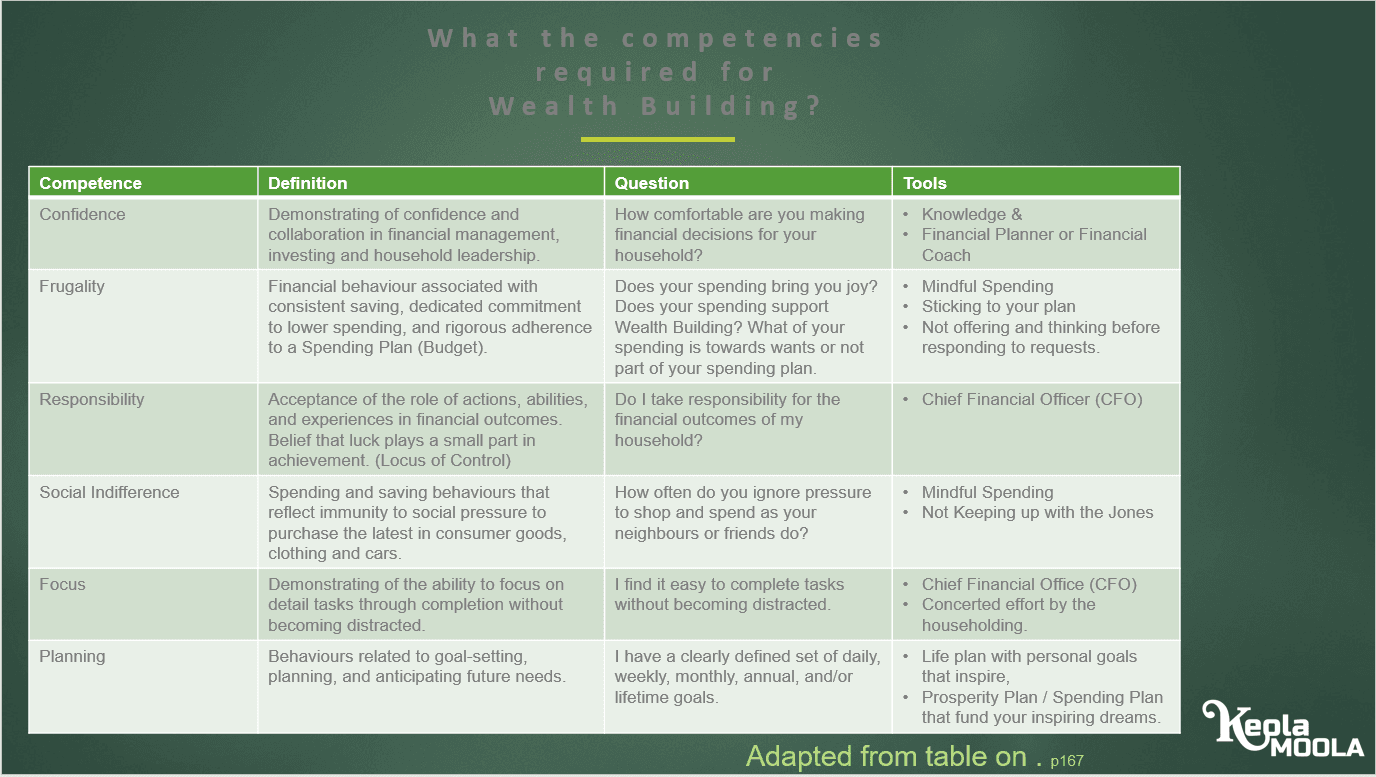
Wondering which wealth-building muscles, you still need to flex. You can do a free assessment by completing the twelve questions following the link:
Really valuable information and stories shared in the book, making it a valuable read.
In this conversation, we discuss what learners attending our three-day financial coaching course can expect from the training.