
In previous conversations, we discussed that our client and we engage in discussions with our unique structure of interpretation, and the wonder of coaching is that we can meet the client where they are. From an ontological perspective, we also said that how we see the world is determined by the language we use, the mood we embody, and our bodies. In this article, we will explore language.
OUR LANGUAGE CREATE OUR REALITY
Listen with curiosity. Speak with honesty. Act with integrity. The greatest problem with communication is we don’t listen to understand. We listen to reply. When we listen with curiosity, we don’t listen with the intent to reply. We listen for what’s behind the words. ― Roy T Bennett,
When we speak, we usually want to share or achieve something through the language we use. It could be telling people how things are, trying to encourage people to do tasks, committing ourselves to do certain actions, expressing feelings and attitudes, or bringing changes through our utterances. Language enables us to create narratives that become our realities of taking action or taking no action for ourselves or others.
In Searle’s book, Speech Acts, he states that effective communication requires essential building blocks. These building blocks involve that our words need to be authentic, honest, and spoken with integrity. Our words need to be sincere. The information needs to be appropriate in style, form, nature of communication, and relevant to the context.
We initiate six actions through language:
- Assertions establish and create a shared understanding of reality for a particular group or community as a basis for coordinating meaning and action.
- Assessments are shaped by our values, beliefs, judgements that we make, our preferences and prejudges. Assessments are a particular interpretation of a situation in preparation for action.
- Declarations are a commitment we make to create a new context for action.
- Requests are to ask somebody else to act.
- Offers are where we commit to act on behalf of somebody else.
- Promises are mutual commitments for future action.
In summary, we can say that language creates reality. If our current reality is no longer serving us, we need to create a new narrative.
In future articles, we will further explore how certain language patterns either serve our clients on their journey to prosperity or not.
In the following Ted Talk (14 Minutes), Lera Boroditsky shares some interesting thoughts on language. As you listen to this talk, I invite you to reflect on how our language and culture influence our thinking about life and wealth. How does this manifest in the language we use? How does this impact us to take action?
FINANCIAL COACHING ENGAGEMENT FRAMEWORK
The following question often pops up in conversations around financial coaching: Do I always have to engage in a formal coaching process that consists of multiple sessions?
We will explore the question by looping back to our conversations over the past few weeks and then expanding.
In Facilitating Financial Health, Tools for Financial Planners, Coaches and Therapists, the authors share a financial facilitation decision tree that I adapted to align to the Ontological Coaching model.
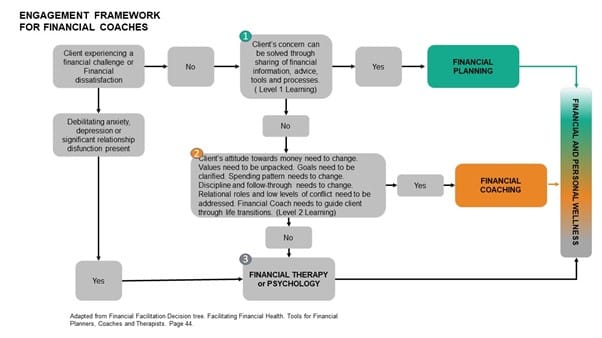
With reference to the diagram, we can see that we engage with a client and are experiencing a specific challenge that they voice to us. We ask a few questions and assess that (diagram point 1) client concerns can be solved by sharing financial information, advice, tools, or new processes. For example, clients only need factual information or a product to address their concerns or need. As discussed last week, this is level 1 learning.
The alternative can be that we assess our client needs to:
- Change their attitude towards money,
- Align their values, meaning and money,
- Build the competency to manage their money,
- Plan for a significant life transition, and
- Aid them when they are experiencing a major life transition.
All of the above are examples where most clients will need to change their structure of interpretation or require new skills.
We now know we need to explore their way of being, to enable level 2 learning (diagram point 2). As the client needs to broaden their language, adopt a mood that will support them and embody a new way of observing the world to deal with the concern or challenges.
It is also important to note that when our client is experiencing debilitating anxiety or significant relationship dysfunction, it is our ethical responsibility to refer them to a therapist or psychologist (diagram point 3). Secondly, suppose we cannot support our client either due to differences in values or personality, as examples. In that case, it is also our responsibility to refer the client to another financial coach or planner.
Back to level 2 (diagram point 2) learning, we need to perform certain types of engagements to support our clients to change how they observe and address their concerns or challenges. Let’s see how we can approach these engagements.
TYPES OF COACHING ENGAGEMENTS
James Flaherty shares three types of coaching conversations in his book, Coaching, evoking excellence in others, and we will use his model as a distinction for our discussion.
He shares the following quote in the introduction to the chapter that is very relevant to coaching:
“He has to see on his own behalf and in his own way the relations between means and methods employed and results achieved. Nobody else can see for him, and he can’t see just by being ‘told’, although the right kind of telling may guide his seeing and thus help him to see what he needs to see” – John Dewey (Flaherty, 2005, p. 125)
The quote re-iterates the approach that the quality of conversations will determine the quality of our coaching conversations. The quality of our coaching conversations can be assessed by the awareness we create with our clients, and the new action the client will take, to lead a more joyous life with less suffering.
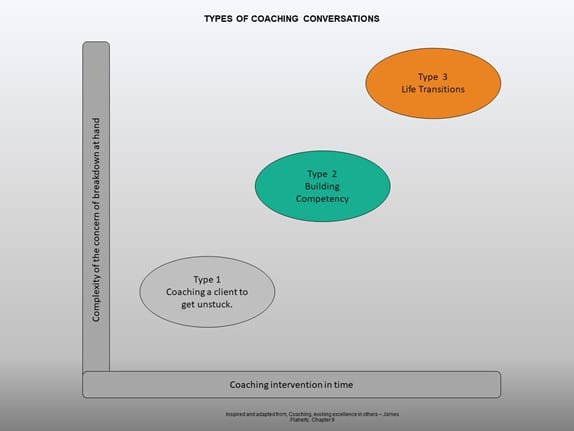
On the vertical axis, we have the complexity of the concern or breakdown of our client. If we view complexity from a financial coaching perspective, we can also say how ingrained the breakdown is, and how it became a part of the client’s way of coping with life over the years. On the other hand, complexity could also be that life happens, for example, the client unexpectedly gets retrenched, and their identity is their job. They now need to deal with the change, find themselves and recreate a new life of meaning.
On the horizontal axis, we have the intervention time we will spend with the client to coach the client on the concern or breakdown.
TYPE 1 – IMPROMTO FINANCIAL COACHING
Impromptu coaching will generally show up in our conversation with a client, colleague, or employee. We will then, at the moment, use our coaching skills and, with permission, explore what we are observing and how it is serving the client, using parts of the 10-Step Coaching Process that applies to the situation.
The following is some examples:
- The client is making some assessments based on generalisations about investment returns and the best funds in the market.
- The client is continuously complaining about life in general.
- The client is struggling to take action based on a request. An example could be providing specific information required for the FNA or executing the plan.
TYPE 2 – COACHING FOR FINANCIAL COMPETENCY
Our engagements with the client indicate that they want to build a specific competency, a new way of being to enable them to be more effective in building prosperity or life a better lifestyle. These coaching interventions will typically be structured over some time, say six months.
The following is some examples:
- The client battle to stay within budget.
- Couples have conflicts around managing their finances and their roles in managing their finances. This is a good example, where depending on the challenge, it could require either type 1,2, or 3 coaching or therapy.
- The client uses long-term savings to fund a short-term lifestyle.
TYPE 3 – LIFE TRANSITIONS
This coaching typically originates either from being pro-active and planning for certain life transitions or life happens, and the client needs to deal with the life transition all of a sudden.
The following are some examples:
- The client wants to start a side hustle
- The client just heard they are retrenched
- The client needs to retire in five years.
- The client’s partner just passed away.
Bibliography
Flaherty, J., 2005. Coaching, Evoking excellence in others. 2005 red. Burlington: Elsevier.
Klontz, B., Kahler, R. & Klontz, T., 2016. Facilitating Financial Health, Tools for Financial Planners, Coaches and Therapists. 2nd red. Erlanger: The National Underwriter Company.
As financial coaches we see clients seek our services when they are experiencing some or other challenge and/or concerns that they cannot solve or see new possibilities for. For example, they get retrenched or battle to make ends meet.
Alan Sieler quotes psychiatrist R.D. Laing in Coaching to the Human Soul, Ontological Coaching and Deep Change, Volume 1:
“The range of what we think and do is limited by what we fail to notice. And because we fail to notice that we fail to notice, there is little we can do to change until we notice how failing to notice shapes our thoughts and deeds.”
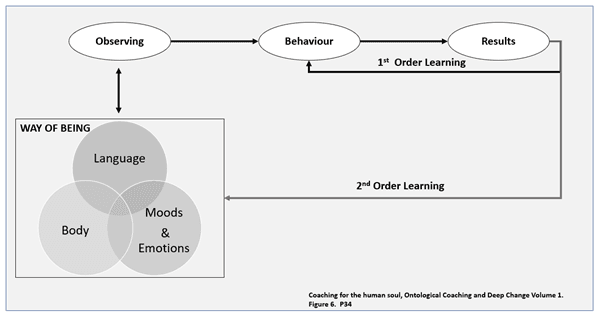
As financial coaches, we are curious to help our clients expand their way of observing. This can also mean the expansion of their structure of interpretation. As our clients develop the way they observe the world, new possibilities open up to them.
Let’s explore the above figure and see how it notes how we can support our clients to explore new possibilities through first-order and second-order learning.
First-order learning is where we are observing and how the behaviour influences the results. An example could be that our clients are battling with managing their monthly income and expenses. During a consultation, it is clear that they do not use any form of budgeting. We take them through a process to work through their income and expenses and offer them an app or spreadsheet to help them keep track of it. It is through these steps that they learn the process of budgeting. In First-order learning, the focus is on how to change behaviour. Behavioural change is approached by adopting strategies, tools, techniques, and procedures.
As financial coaches, we are also curious to understand how our clients view the process of managing their money (2nd order learning). What mood or emotion is created by not managing their money? As it could be that their current financial situation or a past financial crisis can cause them shame or anxiety to budget. What assessments are they making around money and budgeting? For example, a client’s response may be, ‘We, in any case, do not have enough! We spend our hard-earned money on what is essential at that moment. Tomorrow will be taken care of.’ By exploring, with the permission of our clients, how their moods, body, and language influence how they see their finances and how they then act, we can help them explore alternative ways of observing and managing their money. Second-Order learning enables the client to observe and see differently.
In most cases, second-order learning also enables our clients to engage more effectively in first-order learning.
“People are generally better persuaded by the reasons which they have themselves discovered than by those which have come into the mind of others.” Blaise Pascal
Challenge yourself for the next week to observe:
- Where you offer advice,
- Where you offer tools, techniques, and processes,
- Where you observe your clients’ way of being and offer coaching to explore how their current moods and language are possibly no longer serving them.
Bibliography
Sieler, A., 2003. Coaching to the Human Soul, Ontological coaching and deep change, Volume 1. 2007 red. Victoria: Publishing Solutions.
As promised in the previous blog, let’s explore ten points of financial planning where human behaviour is critical to the success of our clients to enjoy financial prosperity now and in the future.

Today, we will touch on each of these to spark curiosity, questions, and conversation. In future newsletters, we will unpack these integration points in more depth.
Client concerns and communication style
Our customary greeting: “How are you?” is often met with a typical response: “Doing great, thank you and you?”. However, this greeting embodies our client’s unique stories, concerns, and possibilities.
I love the greeting in our African languages such as Sawbona, meaning ‘I see you’ and ‘Dumela, wena o kae?’, meaning ‘Good day, where are you?’. As financial coaches, we are curious to understand our clients as unique human beings, where they are. With the understanding that we and our clients is already somewhere.
This leads to the following questions, that come up for me, in no particular sequence of importance:
- What is my client’s concern?
- What are the unspoken challenges?
- What is my client’s preferred communication style?
- What environment will best support my client on their journey to prosperity?
Contracting
We can see this part as a conversation for a relationship. It is the understanding of the client’s concerns, the sharing of our value proposition, and the approach we have toward the client. It is essential to remember our business processes, and financial jargon is second nature for us. It could be helpful to share an infographic in layman’s terms of what the client can expect from the process and the outcomes. The coaching dance to prosperity can start if both parties are comfortable with each other, and understand the engagement process, expectations, and associated fees.
Money Narrative
Our client’s personalities and values contribute to their attitude towards money. Their values are a key driver of what is essential and create meaning for them. When we, as financial coaches, understand what creates meaning for our clients, we can be much better thinking partners for our clients on their journey to prosperity.
However, there is a second part that we are curious about: the successes and challenges our clients experienced regarding money and life during their lives. As these events will have shaped their money narrative and attitude towards life.
Thirdly, the household, community, and culture in which clients grew up and live will contribute to some of the assertions, assessments, and beliefs our clients have. It will also influence their money narrative. It is vital to understand this and how these beliefs serve them.
We must understand our client’s money narrative so that we can support them to design, plan and live a life of prosperity, now and in the future.
Wealth competencies
The Next Millionaire, Next Door, Enduring Strategies for Building Wealth identified key competencies to create and sustain Wealth (Stanley & Fallaw, 2019). If we compare these competencies with the research on the drivers and behaviours required for financial satisfaction, they overlap.
Some of these competencies are frugality, financial confidence, control, focus, planning, and monitoring.
If we understand our clients’ strengths and struggles, we can coach them to build financial muscles.
Goals and Possibilities
When they walk into our office or engage in a Zoom call, most clients have not applied their minds to how they would like to design their future life and what they are doing to move towards it. Research confirms that asking clients what their goals are is ineffective, and much better results can be achieved by facilitating a process with clients to think of their future life, and then engineering it backwards.
As financial coaches, we can support our clients to explore new possibilities for a quality life of prosperity beyond saving for children’s education and retirement. We help clients design and live their lives to the fullest now and in the future with their resources.
Research indicates that many clients battle to identify and plan for long-term goals and then stay committed to the declarations they made.
Managing flow of money
A good friend and mentor of mine always jokingly says, “Do you want to sleep well or live well.” The moral of the story is that money spent cannot be saved, enabling us to build wealth to ensure financial independence at a certain point and time in the future.
I would argue that part of our role as financial coaches is to help our clients develop a strategy that enables them to sleep and live well throughout their lives.
Life transitions
It is one thing to have goals and plans; however, what if life happens. Most clients plan for transitions like death, disability, retirement, and kids’ education. However, life is not linear; what happens if the client gets retrenched five years before planned retirement with two kids still at Varsity or an elderly parent’s health deteriorates, and the client needs to support them financially.
I see our role as Financial Coaches is to facilitate these conversations with our clients to proactively plan for possible transitions, be there when our clients need to navigate through the change, and help them build a new phase in life after the transition took place.
Modelling and managing life in flow
Life is dynamic, and as our clients live their lives, we, as financial coaches, help our clients navigate complex matters of financial planning and the emotions they experienced surrounding money and life, and the relationships they cherish. We can act as their thinking partner through these changes, planning, emotions and relàtionships.
As part of this process, it is sometimes challenging for a client, 30 years old, to envisage that today’s decisions can affect their dream of being financially independent at age 50. Suppose we can build and model these scenarios for our clients in a simplistic way. In that case, we can get them emotionally engaged in their plans and give them peace of mind that what will happen if certain unexpected life transitions occur.
How does the dashboard look that we monitor our client’s dreams? What vitals do our clients monitor to measure their financial health?
Implementation
Research indicates that only 20% of clients are change-ready for advice that planners over to clients. As we are taking a coaching approach to planning, we are working with the client’s agenda. We are taking into consideration what the client deems as important and implementing solutions that they initiate.
Cheerleading and Accountability
As financial coaches, we are cheerleaders. We support our clients on their journey to financial prosperity. However, we are also curious to understand with our clients what breakdowns they experience when they do not achieve the outcomes they set out to achieve.
Bredan Frazier says financial planning is 95% behaviour. Reading through the above, I leave you to be the judge of that.
I know I am biased. However, I will say as a crazy financial coaching artist, financial planning done right, is done in a financial coaching way.
In the next blog, we will explore the two different approaches to financial coaching.
Last week we explored What is Financial Coaching and I shared the following definition:
Financial Coaching enables clients to achieve long-term prosperity by developing the competence to self-correct and self-generate. It is a collaborative process centred around the client’s agenda. The coach uses their tools of deep listening and powerful questioning to help their clients determine the direction, resources, relationships, and self-knowledge required to get them to where they want to go, living a life of purpose.
I received the following questions:
- How do you define prosperity?
- What do you mean by purpose?
- Can you please expand on the definition?
In this article I respond to these questions, using our Purpose Driven Financial Coaching framework.
Purpose-driven financial coaches focus on supporting clients and their loved ones to live a life of purpose while acquiring prosperity and navigating life’s transitions. Ultimately clients want to live in flow and be content.
We define purpose as, living a life of meaning, where the drive comes from living one’s values and collaborating with others creates belonging and value for self and others.
We define prosperity as, thriving while living one’s purpose. Money is just a resource that is needed to fund and maintain a life of prosperity.
We define being inflow, as an optimal state (language, mood and body) function with available resources to live a life of prosperity effortlessly and to grow and sustain wealth, health and resources to maintain the state now and in future.
As purpose-driven financial coaches, we acknowledge that:
- We are human, and that our way of being is critical in the financial coaching and planning process,
- We engage with each client as a human being and are deeply interested in their life and their success,
- An authentic and trusted relationship with our clients is vital for us and
- We always strive to deliver objective guidance and advice to our clients to support their ambitions, dreams, aspirations and support them through their life transitions as a thinking partner.
The purpose-driven financial coaching framework aims to integrate (1) focusing on the client as a human being, (2) the potential life-changing events that could impact on their planning, (3) map client’s ambitions, the impact of possible life-changing events on these and jointly plan for success, (4) through wise counsel support clients to implement optimal solutions, and lastly (5) act as an accountability partner to motivate, recognise and keep client accountable for sticking to their plans and help them to adjust plans where life happens.
We will unpack the framework further in the newsletter next week, looking at the integration points with financial planning through the lens of putting the client at the centre of the conversation.
In last week’s post, we explored if we needed to wear different hats when coaching and/ or giving advice. This week we will ponder on the question of ‘What is coaching?’ and then look at some definitions concerning financial Coaching in particular. I think it is an essential distinction for us to explore as the term coaching and, more so in our context Financial Coaching is used broadly. These definitions will also guide us to better questions such as ‘Is there a shared understanding of what our clients can expect from a Financial Coaching engagement?’ or ‘What we will offer our clients as financial coaches?’
WHAT IS COACHING?
Doing a literature review on the definition, I soon ended up with three pages of definitions of Coaching. The following represent some of the core themes from the study:
In the broader context coaching is referred to as a process of change, self-reflection, personal satisfaction, the fulfilling of full potential, enhancing effectiveness, achievement of goals, improving performance, self-awareness, social awareness, meaning-making on a personal and social level by telling stories (Askew & Carnell, 2011; Stelter, 2007; Stout Rostron, 2012).
James Flaherty (2010) argues it helps that we start by defining what our intention is with our Coaching:
The intended outcomes of Coaching are to achieve “long-term excellence, the competence to self-correct, and the competence to self-generate” (p.11).
My good friend, coach, and mentor Michell Clark, from MotivCoach, posted the following reflection on her Instagram some time ago. The post also offered a great distinction on some of the other modalities we can use to support clients to address their concerns and breakdowns:

⠀⠀⠀⠀⠀⠀⠀
“Over the past 4 years, I have had the privilege of playing the role of Head Tutor for coaching students on our 13-week online course.⠀⠀⠀⠀⠀⠀⠀⠀⠀
When the students write their first introduction note they say “I have been coaching for many years and I am here to formalize it”.⠀⠀⠀⠀⠀⠀⠀⠀⠀
About halfway through the course, they write “I THOUGHT I was coaching but I was not!”⠀⠀⠀⠀⠀⠀⠀⠀⠀
.⠀⠀⠀⠀⠀⠀⠀⠀⠀
If you are teaching your clients stuff, you’re teaching, not coaching. ⠀⠀⠀⠀⠀⠀⠀⠀⠀
If you are offering your clients stories from your own life, you are mentoring, not coaching. ⠀⠀⠀⠀⠀⠀⠀⠀⠀
If you are solving the challenges your client has by offering advice, you’re advising and consulting, not coaching. ⠀⠀⠀⠀⠀⠀⠀⠀⠀
If you are shooting the breeze with your clients, you’re chatting, not coaching. ⠀⠀⠀⠀⠀⠀⠀⠀⠀
If you are setting the agenda for each meeting based on your own plans of how this should all go, you’re driving, not coaching. ⠀⠀⠀⠀⠀⠀⠀⠀⠀
.⠀⠀⠀⠀⠀⠀⠀⠀⠀
Know your role as a coach! ⠀⠀⠀⠀⠀⠀⠀⠀⠀
You’re walking alongside your client in a partnership of equals. Your client is the expert and you are the expert coach. Use your tools of deep listening and powerful questioning to help your client to determine the direction, the resources, the networks, and the self-knowledge required to get to where they want to go. ⠀”
WHAT IS FINANCIAL COACHING?
Let’s now explore some of the definitions of financial Coaching:
Saundra Davis defines Financial Coaching as: “Financial Coaching works to narrow the gap between what people know and what they do; it illuminates—through thoughtful questioning—what gets in the way of meeting life goals.”
Association for Financial Counseling and Planning define Financial Coaching as, ‘Financial Coaching is a collaborative, client-centred process that supports an individual’s financial progress and wellness using skills and techniques that facilitate lasting financial behaviour change.’
In the following video (2 Min), J Micheal Collins from the University of Wisconsin-Madison shares his thoughts on financial Coaching.
To beg, borrow and steal from the above leaders in the field of Coaching, I would say:
Financial Coaching intends to enable clients to achieve long-term prosperity by developing the competence to self-correct and self-generate. It is a collaborative process centred around the client’s agenda. The coach uses their tools of deep listening and powerful questioning to help their clients determine the direction, resources, relationships, and self-knowledge required to get them to where they want to go.
Resources:
Askew, S., & Carnell, E. (2011). Transformative Coaching. A learning theory for practice. Institute of Education.
Flaherty, J. (2010). Coaching: Evoking excellence in others (3rd ed.). Elsevier.
Stelter, R. (2007). Coaching: A process of personal and social meaning making. International Coaching Psychology Review, 2(2), 191-201.
Stout-Rostron, S. (2012). Business coaching. Wisdom and practice (2nd ed.). Knowledge
Putting myself in the position of a Financial Planner, Accountant, Coach, Therapist, or Psychologist who wants to learn more about financial coaching and expand my value add to my clients, where do I start looking for the right course for me?
As a financial coaching artist, practitioner and provider of financial coaching training, I will endeavour to keep my thoughts on the matter as objective as possible. I love learning and am on a continuous quest to learn more about coaching, human behaviour, and financial coaching. In the post, I will share the framework I use to evaluate courses or programs:
- My objective
It is crucial to ask yourself:
- How will this course support your personal development and whom you want to become?
- What is your intention?
- What are your expectations of the course?
- How will the course support you and your stakeholders?
Understanding why you want to enrol for a Financial Coaching course is paramount as you want to be clear that your intention is clear to enable you to apply your full attention to the course.
2. Philosophy
The quality of the financial coaching course will depend on the coaching philosophy’s quality that underpins the coaching model and the integration with the financial planning framework.
As for the financial coaching model or philosophy, it is vital to ensure that it is a well researched and recognised model and that the facilitators have deep knowledge and experience. Also, do some reading and watch some youtube video’s of the philosophy to see if you resonate with the model.
Integrating the coaching model with a financial planning framework like the six steps process is essential, allowing you as a learner to create a language and distinction relating to financial coaching that you can apply in practice.
3. Course Content & Structure
Usually, the provider will supply you with a prospectus that gives you a view of the course’s content and how the course is structured.
Looking at the course content, you will be able to determine if the course will be able to address your expectations, secondly, if there is an integration between coaching and financial planning.
The two most crucial points around the course structure need to include co-hort learning. From personal experience, rich knowledge sharing and integration happens between learners in the class or virtual class. Secondly, there needs to be enough space between sessions to integrate the learning into practice. Coaching is all about integrating a new way of being into the way of delivering financial planning.
If you want to become a credentialed coach or financial coach, do the provider’s courses build your skill and competency to become credentialed as a coach.
Ask what will you have achieved on completion of the program? What skills will you gave learned?
4. Provider
Is the provider reputable?
Is the provider a registered education provider?
Is the provider a registered provider at the Financial Planning Institute?
Is the provider a registered provider at COMENSA or ICF?
What will the social proof of the education be for your clients on completion?
Depending on the type of course you want to do, all these are important. However, if you’re going to venture on a journey to become a credentialed coach, these are essential factors to consider.
5. Facilitators
Do the facilitators have experience in coaching, financial coaching, and financial planning? Preferably a combination.
Suggest you make a shortlist and then set up a call with one of the facilitators and meet them and discuss the course content. This will serve you well as this conversation will indicate that you resonate with the facilitator and how passionate the facilitator is about the content and the future of financial coaching.
6. Professional Bodies
Is the course or program registered at SAQA?
Is the course accredited with Financial Planning Institute?
Is the course registered at COMENSA
Depending on the type, of course, you want to do, all these are important. However, if you’re going to venture on a journey to become a credentialed coach, these are essential factors to consider.
7. References
Still not sure talk to some learners that attended the provider’s courses in the past. With POPI, this is not that easy. However, most providers will have a list of students who gave permission to share their information in such cases.
8. Cost
Lastly, you can look at the cost of the program and the value you will reap on completion of the program.
This is a question that continuously pop-up in conversations. In this post, we will ponder on this question.
If we rewind ten years to where I was talking to a group of final year university students about the possibility to explore a career in the Profession of Financial Planning my conversation would look a lot different to today. I would have shared that we bring together the world of Accounting (Cashflows, Taxes and Numbers) and the world of Law (Buy and sell agreements, Contracts and Wills) as Financial Planners for our clients to support them living their best lives possible. We ensure integration for our clients to see the bigger picture and have peace of mind by mitigating and managing their risks.
Having that same conversation in 2022, I now know that each client we engage with is a unique human being, with a unique personality, with something special that creates meaning and purpose for them. As our clients live in an ever-changing ecosystem where money is one of the resources on their journey. We still bring integration; however, we are their thinking partners as we create awareness and help them unlock meaning and take accountability for their lives.
As financial coaches, we bring together the following interrelated parts of our clients’ lives to support our clients to become and sustain prosperity and live meaningful lives:
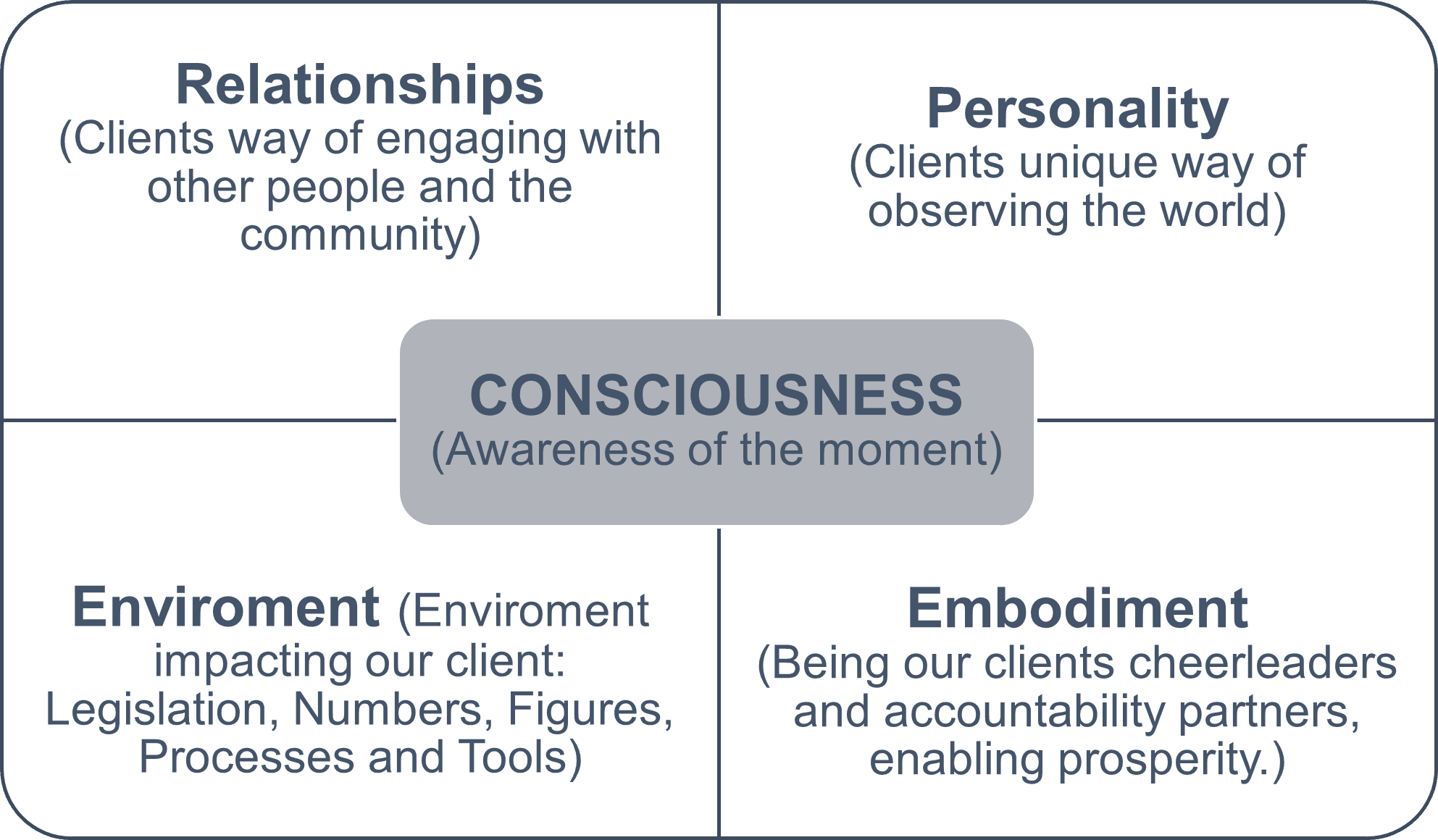
We, as financial coaches, are curious to understand these interrelated parts and explore, with our client’s permission, how it influences their quality of life and supports them to achieve what is important for them.
Consciousness: As Purpose-Driven Financial Coaches, we want to continue improving our ability to be present in the moment and observe our way of being and that of our clients. We do this using the ontological philosophy of observing Language (Listening, Questioning and Speaking), Moods and Body.
Personality: As financial coaches, we want to understand our clients’ unique personalities, communication styles, values, and dreams. We want to observe what creates meaning for our clients. Although we, as coaches, are not psychologists, we can draw on some of the research and practices of psychology. As it can supply us with a better understanding of our clients as human beings and how we can be their thinking partners on their journey to financial and personal wellness.
Relationships: Our clients do not live in isolation. They are born and grow up in households and communities that influence their language, cultures and belief systems. As our clients go to school and later further their studies, formally or informally, they form social networks that further influence the abovementioned factors. Then they start to work which leads to additional social networks and influences. This cycle continues, adapt and changes as our clients’ create new relations and discover new incites. As financial coaches, we want to observe what creates belonging and influences our clients’ way of observing the world. We can draw from sociology to better understand these dynamics.
Environment: As financial planners, potentially this part of our engagement with our clients comes most naturally as this is home for us. We offer our clients advice and solutions through our understanding and analysing of the numbers. The understanding needed for this part is already a daunting task as we need to consider the world of accounting (Tax and Numbers) and law (Contracts). In this domain, influential or changing, factors to the client’s environment include retrenchment, reallocation, or markets corrections, as a few examples.
Embodiment: As financial coaches, we want to have quality relationships and conversations with our clients to enable them to change how they observe the world, to allow them to adopt a new language, moods and processes that will support them on their journey to financial prosperity. We act as cheerleaders and accountability partners as part of our role as financial coaches. In this capacity, we also have conversations with our clients which ensure the successful execution of agreed outcomes.
Can we then say we dance the above integration dance with our clients as they navigate through the natural life cycle and experience multiple life transitions?
What is the answer, then?
This leaves me with some personal questions:
- What changes if I embody a new way of being as a planner, and\or as a financial coach?
- How does this new way of being, influence my advice process?
- What will serve my clients and me best; Wearing two hats, that of coach and planner, or an integrated approach of a coaching way to financial planning?
Many people take no care of their money till they come nearly to the end of it, and others do just the same with their time. -Johann Wolfgang von Goethe
Do you sometimes find yourself at night lying awake worrying about how you will pay next month’s rent? It’s raining and the roof you replaced is still leaking? Your medical aid are refusing to pay for your child’s operation?
You are not alone. The good news is, stop feeling embarrassed. 58% of South Africans indicated that they experience financial stress.
How do you become part of the 12% of South-African’s that are not experiencing any form of financial stress? My blog has suggestions for you.
The three primary sources of Financial Anxiety are Financial Dissatisfaction, Life Transitions and Financial Abuse. In this post, we will focus on the primary drivers of financial satisfaction. Which of these three do you relate to? Perhaps all three?
My research indicates that clients satisfied with the the role finances play in their lives display these behaviours:
- They do not borrow for short-term spending. They have a Freedom Fund to fund emergencies. They will also not make use of credits cards and store credit.
- They have an active saving strategy.
- They have clear, documented goals and are working towards these goals with focus.
- When unforseen events happen, they adjust their spending
- They manage credit use, as they know that it is better to earn interest than to pay interest. They also have a mindset that credit is a sign that they are living beyond their means.
- They keep track of income and expenditure.
- They will shop around for the best prices before buying or engaging in a contractual agreement.
It is then clear that by focusing on the following five behaviours, we can increase our financial satisfaction and decrease economic anxiety
- Set clear goals that are documented in a written plan
- Eliminate short-term borrowing.
- Create a Freedom Plan equal to 3to 6 months monthly expenses.
- Have a budget or spending plan to ensure you manage the money that flows through your fingers.,
- Think about larger and contractual purchases and their impact on your long-term goals.
Reading this, you most probably will go, yes, yes. We have heard this previously. So what keeps people from engaging in these basic acts?
Your money personality drives your financial behaviour. Research indicates that you need to build muscles to ensure that you can engage with discipline in the correct money behaviour:
- Acquire the appropriate level of financial knowledge so that you can act with confidence.
- Your money attitude will inform how you see and engage with money. Your attitude towards money is formed by your personality and events that shaped your relationship with money over the duration of your life. This attitude will inform how you relate to saving and spending as well as your future orientation towards money. Your attitude not only informs how you will manage your money, it directly influences your level of financial satisfaction.
- Your sense of control helps you to frame spending so that you can curb spending and secondly enable you to think pro-actively about your finances.
To help you build your behaviour muscle, it will benefit you to work with an experienced financial coach or financial planner with a coaching qualification. Such a person can guide you to understand your relationship with money. Secondly, this person can help you craft and implement a financial plan, support your dreams and be your cheerleader on this journey. To enable you to enjoy life now as well as in the future with the resources you have. We all need cheerleaders on our team.
I wish you a good night’s rest free from money worries.
Want to do a free financial health check, will take you five minutes.
In this talk at the Next Gen 2021 Conference, I share my view on how important financial coaching is for financial planners.